
What does scale in old cast iron drains usually mean?
Scale in old cast iron drains means hardened material has built up inside the pipe and narrowed the bore. We treat it as a sign of restriction, not a full diagnosis, because the cause can be ordinary blockage, attached deposits, pipe failure, or a mix of those issues.
A drain that keeps backing up after basic clearance is telling you that something inside the line is still reducing flow. That might be a soft blockage that was never fully removed. It might be cast iron drain scale attached to the wall. It might be a defect that keeps catching waste.
Old cast iron can become rough internally as it ages. Once the inner surface is rough, deposits have more places to grip, so the pipe restriction builds again after each temporary clearance. That is why repeated blockage alone does not prove that descaling is the answer.
We separate the problem into three plain categories: deposit problem, pipe condition problem, or both. Descaling belongs in the first category. Cracks, holes, open joints, serious wall loss and collapse sit in the second. Many older commercial drains sit somewhere between the two, which is why evidence matters before work is recommended.
Why do old cast iron drains scale up in Reading and the Thames Valley?
Old cast iron drains in Reading, Berkshire and the Thames Valley can narrow through mineral scale, corrosion deposits and foul drainage build-up. Hard water is part of the local picture, but it does not explain every cast iron pipe restriction we see.
Thames Water states that all water in its region is hard because it passes through chalky limestone, and its hardness categories class hard water as 200 to 300 mg/l CaCO3 and very hard water as more than 300 mg/l CaCO3. That supports the possibility of mineral scale in local pipework, especially where water and waste have passed through the same route for years.
Cast iron foul drains, though, collect more than mineral deposits. Grease can bind material to the pipe wall. Silt can settle where flow is weak. Rust deposits can form around corrosion points. Uric scale can build in waste lines serving toilets and urinals. Concrete residue or building debris can also create a hard obstruction if it entered the drain during past works.
| Material | Where it usually comes from | What it means for descaling |
|---|---|---|
| Mineral scale | Hard water carrying calcium and magnesium | Descaling can remove mineral build-up where the pipe wall allows safe cleaning |
| Rust scale and rust nodules | Corrosion on the inside of cast iron | Removal can clear restriction, but the corroded wall still needs judging |
| Fat, oil and grease | Commercial kitchens, wash-down areas and food waste lines | Grease may need a different cleaning stage from hard scale removal |
| Silt and general debris | Low-flow areas, poor falls or material washed into the drain | Cleaning may clear the bore, but the reason it settled still matters |
| Uric scale | Toilet and urinal waste lines | Descaling can remove the deposit, subject to the condition of the pipe |
| Concrete residue | Material that has entered the drain during works | Hard removal may be possible, but CCTV evidence is needed before promises are made |
The practical point is simple: one blocked cast iron drain can contain several materials at once. If a contractor treats every restriction as limescale, they risk recommending the wrong work.
Honest advice and free quotes across Reading, Berkshire and surrounding areas.
Get a Free QuoteWhat does descaling actually remove from a cast iron drain?
Cast iron drain descaling removes material attached to or lying within the host pipe. It is controlled cleaning of the internal bore, and its value depends on what is restricting the drain and how much sound pipe remains behind the deposit.
Descaling removes internal deposits
Descaling can remove hard internal drain deposits, rust scale, grease-related build-up, silt and debris where access and pipe condition allow. Specialist equipment guidance from Picote Solutions treats proper pipe preparation for coating as the removal of scale, grease, dust, standing water and other debris from the host pipe. That distinction matters because a pipe must be clean before any lining or coating decision has real value.
Grease deserves separate treatment because it behaves differently from hard scale. Heavy fat, oil and grease build-up may need degreasing during cleaning, which is a different problem from cutting away rust scale or mineral deposits. A single word such as scale hides that difference.
Removing rust deposits is not the same as repairing corrosion. Once corrosion has eaten into cast iron, clearing the bore may expose what is left of the pipe wall. That can be useful evidence, but it is still evidence, not repair.
Descaling does not repair pipe failure
Descaling does not rebuild cast iron. It does not close holes, seal open joints, correct bad falls, restore wall thickness or reverse collapse. If the pipe has failed structurally, cleaning the inside may make the defect easier to see rather than remove the underlying problem.
We draw that line firmly because it protects your budget and your building. A drain that is mainly narrowed by deposits may respond well to descaling. A drain with serious wall loss may need relining, excavation or replacement once the condition is proven.
Hydro jetting and descaling are related, but they are not the same decision. Jetting can move soft blockage and loose material. Descaling deals with harder deposits attached to the internal surface. The right choice depends on what the CCTV survey shows inside the pipe.
Before any descaling is approved, make sure the CCTV footage shows how much sound pipe remains behind the deposit. That evidence decides whether cleaning is enough or whether the line needs repair.

How does CCTV evidence change the descaling decision?
Where a cast iron drain keeps restricting, CCTV evidence changes the decision because it shows both the deposit and the pipe condition. Without that view, descaling can be over-promised and structural repair can be missed.
CCTV is most useful where the drainage problem has commercial consequences or the pipe cannot easily be exposed. We place most weight on camera evidence in these situations:
- Repeat restrictions. A line that blocks again after clearance needs diagnosis, not another blind attempt at the same cure.
- Shared drainage. Thames Water says a property owner is responsible for waste drainage pipes within the property boundary if they serve only that property. Public sewers and shared sewers sit with Thames Water, including shared sewers under a garden or driveway.
- Insurance or sale due diligence. Clear footage gives you evidence of condition rather than a vague note saying the drain was blocked.
- Possible relining. A liner needs a suitable host pipe, so descaling can be part of preparation only if the remaining pipe is fit to receive it.
- Business premises. Where disruption affects trading, tenants, school operations or building use, the cost of guessing wrong rises sharply.
At 24hrs Drainage, we use CCTV evidence to distinguish blockage, scale and structural failure before recommending work. That is the difference between clearing a symptom and knowing what the drain will tolerate next.
For more formal condition evidence, current UK water industry guidance from the Water UK Standards Board points to consistent use of the latest WRc Manual of Sewer Condition Classification standard for sewer CCTV surveys, currently MSCC5, with MSCC6 when available. You do not need to master the coding, but you do need evidence that separates deposit removal from pipe condition.
Before and after footage also changes the conversation. Before descaling, the footage may show how much of the bore is restricted. After descaling, it may show whether the pipe is clean enough for relining or whether defects now point to repair.
If a drain blocks again soon after clearance, treat it as a diagnosis issue. Repeating the same clearance without checking the pipe condition can hide wall loss, open joints or collapse.
How should you judge descaling against relining or replacement?
The tempting route is to pick the option that sounds least disruptive. That can be the wrong starting point with old cast iron drainage, because the drain decides the answer. The useful question is what the pipe is actually suffering from once the internal build-up has been assessed.
Descaling is strongest where deposits are the main restriction and the remaining pipe appears serviceable. Relining becomes more realistic when the host pipe can support a liner and the internal surface has been properly prepared. Excavation or replacement belongs in the conversation where the drain has failed, especially where collapse, serious wall loss or poor alignment has made cleaning alone too limited.
At 24hrs Drainage, we would rather prove the condition first than recommend unnecessary descaling or repair. That approach matters for commercial premises in Reading and across the Thames Valley because downtime, shared responsibility and future works all depend on a sound diagnosis.
Once you separate blockage, mixed scale and pipe failure, the situation stops looking like a recurring nuisance and starts looking like a decision with evidence behind it. The right answer is the one that matches the pipe condition, not the one that sounds least disruptive.
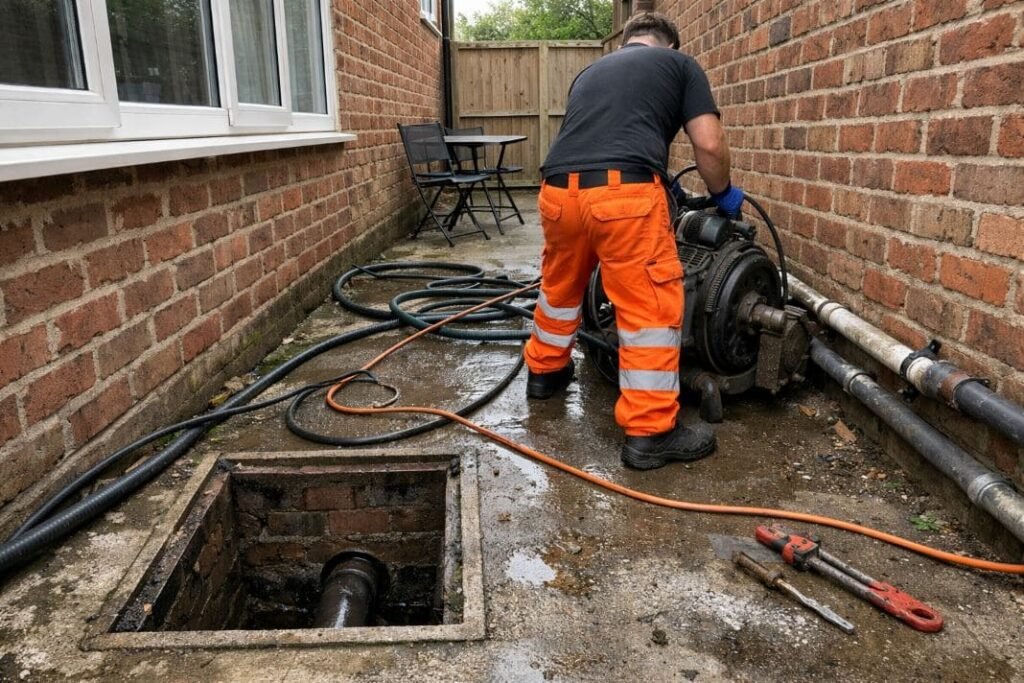
Whatever the problem — blocked, cracked, slow or smelly — we'll diagnose it properly.
Book an EngineerQuestions we get asked about cast iron drain descaling
Can descaling damage old cast iron drains?
Descaling has to be judged against the condition of the pipe. If cast iron has serious wall loss or open defects, aggressive cleaning can expose the failure rather than solve the problem.
Is hydro jetting the same as descaling?
Hydro jetting is mainly used to move blockage and loose material. Descaling is aimed at harder internal deposits attached to the pipe wall, so the two are related but not interchangeable.
Does removing rust deposits mean the corrosion has been fixed?
Removing rust scale can improve the internal bore, but it does not repair the corroded cast iron behind it. The remaining pipe wall still needs checking before relining or repair is ruled in or out.
Why does a cast iron drain keep blocking after it has been cleared?
Repeated blockage can mean the original material was not fully removed, or that hardened deposits and rough internal surfaces are catching waste again. A structural defect can create the same pattern, which is why repeat problems need evidence.
Can a cast iron drain be relined after descaling?
A cast iron drain can be considered for relining after descaling if the host pipe is clean enough and still has enough sound structure to support the liner. CCTV evidence is what confirms whether that route is realistic.
