Is your business responsible if a drain blockage affects a neighbouring property?

When a blocked drain spreads beyond your site, where does business responsibility usually sit?

Responsibility usually depends on where the blockage started, which section of pipe is involved, and who is responsible for that part of the drainage system. A business may be liable if the issue began within its private drainage and caused damage or nuisance next door, but shared drains, property boundaries, leases, and ownership records can make the position less straightforward.

A blocked drain becomes far more serious once wastewater or foul odours start affecting the property next door. At that point, the question is rarely just about clearing a pipe. The real concern is whether your business drain responsibility extends beyond your own land and whether any legal or financial exposure follows.

Table of Contents

Pro Tip: Keep detailed maintenance and incident records for all drainage systems to support faster resolution in case of disputes or claims.

Understanding drainage responsibility: where liability begins and ends

Confusion often starts with a simple assumption that the pipe nearest your building must be yours. Drainage boundaries do not always work that neatly. A drain serving only one property is usually treated differently from a shared drain or sewer that carries waste from more than one premises.

In broad terms, the main distinctions are these:

  • A private drain usually serves one property only and sits within that property’s boundary.
  • A shared drain carries waste from more than one property before joining a wider sewer.
  • A private sewer may lie outside a single property boundary but still serve a limited number of premises.


Property lines matter, but they do not answer every question on their own. Older commercial sites, converted buildings, mixed use premises, and rear access yards often have drainage runs that do not match what owners assume is on their land.

Property deeds, lease plans, transfer documents, and any drainage plans held with the site records can all help clarify drainage liability. The Water Industry Act 1991 also forms part of the background here, particularly in relation to who is responsible for certain sewers and adopted infrastructure. Local councils and, in some contexts, the Environment Agency may become relevant if the blockage causes environmental harm or a wider public issue.

One of the most common shared drain issues arises where two properties rely on the same underground line, but only one occupier notices the blockage first. In that situation, ownership, use, and maintenance history can matter just as much as geography.

Legal framework: what the law says about drain blockages and neighbouring properties

The law does not treat every drainage incident as automatic fault. Liability usually turns on evidence. Investigators and insurers will often look at the source of the blockage, the condition of the system, what the business knew, and whether reasonable action was taken once the problem became clear.

Several legal frameworks may become relevant:

  • Water Industry Act 1991: This helps define parts of the drainage network and can affect which pipes fall to a property owner, occupier, or sewerage undertaker.
  • Environmental Protection Act 1990: If a blockage creates a statutory nuisance, local authority environmental health teams may become involved.
  • General legal liability principles: A neighbour drain dispute may involve arguments about negligence, damage, or failure to deal with a known problem.


Negligence usually requires more than the mere existence of a blockage. A business is more exposed where there is evidence that waste, grease, debris, or misuse from its premises caused the obstruction, or where warning signs were ignored after the issue became apparent. By contrast, an incident linked to an unforeseen collapse in a shared line may point in a different direction.

Local authority environmental health teams tend to focus on practical effects. They may ask whether foul water escaped, whether neighbouring occupation was affected, whether a nuisance is ongoing, and whether prompt remedial action followed. Enforcement action is shaped by the facts, not by assumptions about who is most convenient to blame.

That is why drainage law often feels less like a single rule and more like a chain of linked questions about origin, control, notice, and impact.

Request a Drain Survey

Gain clarity on your drainage responsibilities with a professional survey. Protect your business by understanding system ownership and potential risks.

Book a Drain Survey

Practical scenarios: when is a business actually responsible?

Real cases often sit in the grey area between obvious fault and shared misfortune. Looking at a few common business drain blockage scenarios can make the principles easier to apply.

Blockage within the business’s private drain

A restaurant, workshop, office, or retail unit may have a private section of drain that serves only its own premises. If the source of blockage is traced to that section and overflow then affects a neighbouring property, responsibility is more likely to sit with the business or the party responsible for that part of the system.

Where the blockage is linked to use of the premises, insurers and property management companies may also look closely at maintenance records, previous incidents, and any delay in responding after the problem became known.

Shared drainage between neighbouring sites

A shared line changes the picture. If two or more properties feed into the same pipe, the question becomes whether the obstruction came from one occupier’s use, a structural defect, or a failure in shared infrastructure.

Commercial property drainage disputes of this kind often need evidence rather than assumption. A blockage found downstream of both premises may not point neatly to one side, especially on older plots with altered layouts or undocumented connections.

Tenant and landlord responsibility

A business tenant may occupy the premises, but the lease can place different duties on the tenant and the commercial landlord. Some leases make the occupier responsible for drains serving only the demised space. Others leave structural drainage elements with the landlord, particularly in multi-unit buildings.

Insurance providers and managing agents will usually want to see the lease wording before taking a clear view. On one site, a tenant may be responsible for operational misuse. On another, the landlord may retain liability for a defective underground line beneath a shared service yard.

Accidental incident or preventable issue

Not every blockage is avoidable. Tree root ingress, hidden collapse, or historic defects can cause problems without any obvious fault by the current occupier. Yet once a business becomes aware that its drainage may be affecting another property, the speed and seriousness of its response can still influence the outcome.

That distinction often matters more than people expect.

Pro Tip: Obtain a site-specific drainage plan and update it after significant building or site changes to avoid assumptions about pipe ownership.

Consult Our Commercial Drainage Experts

Receive tailored advice for your drainage concerns and legal obligations. Our team offers clear guidance for property managers and business owners.

Speak to an Expert

Insurance and financial implications: cover, claims, and costs

Drainage insurance issues tend to come into focus very quickly once a neighbouring property is involved. Even where legal responsibility is disputed, a business may still face clean-up costs, interruption, investigation fees, excess payments, and time spent dealing with claims.

Commercial insurers usually look first at the policy wording. Some policies may respond to certain forms of escape of water, accidental damage, or property damage claims from third parties. Others may contain narrow cover, exclusions for gradual deterioration, or limits around underground services.

Common points insurers and loss adjusters may examine include:

  • Cause of loss: Was the blockage sudden, accidental, gradual, or linked to poor maintenance?
  • Evidence: Are there reports, site records, photographs, survey findings, or dates showing when the issue began?
  • Policy exclusions: Does the policy exclude wear and tear, defective design, or long-standing drainage defects?
  • Third-party impact: Has a neighbouring owner or occupier alleged damage, nuisance, or business interruption?


Timing matters here. A delayed response can increase the scale of damage and complicate a business drain claim. It can also make it harder to show what happened first, which section of drainage failed, and whether the business acted reasonably once alerted.

Policy documents deserve a careful read after any cross-boundary drainage event. Some businesses assume their commercial property insurance will cover every drain damage cost linked to the site, but underground infrastructure and liability to neighbours are often treated in more specific ways than expected.

Where an insurer appoints a loss adjuster, the quality of the early evidence may shape the whole conversation.

The role of professional drainage services in resolving cross-boundary issues

Once a blockage affects neighbouring land, an independent technical view can become just as important as the repair itself. Businesses often need clear evidence, a reliable account of what was found, and records that can be shared with landlords, insurers, neighbours, or compliance officers.

Professional drainage services usually add value in three main ways:

  • Assessment: Identifying which part of the system is affected and whether the issue appears private, shared, or structural.
  • Documentation: Producing drain survey evidence, findings, and records that support insurers or dispute resolution.
  • Urgent response: Reducing ongoing escape, nuisance, or operational disruption where time matters.


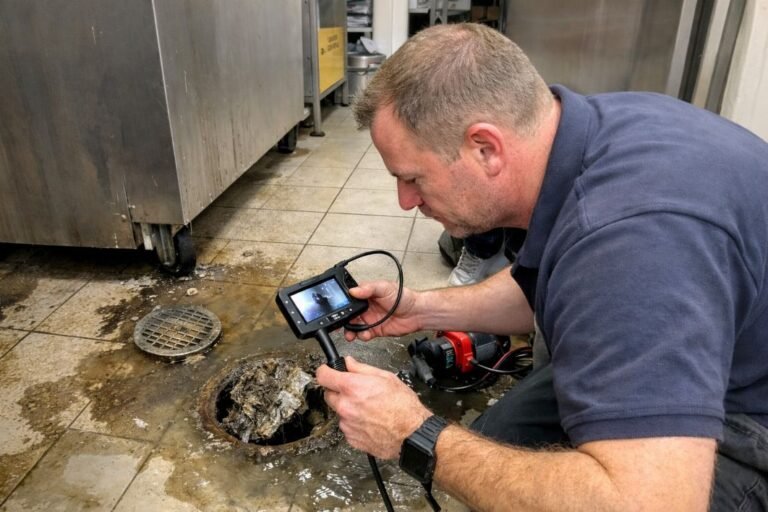
In practice, that can help de-escalate disagreement. A neighbour may believe the fault is obvious, but a proper inspection can show whether the source of blockage sits upstream, downstream, or within shared infrastructure. CCTV survey providers are often used for exactly this reason, especially where responsibility is contested.

For businesses in Reading and Berkshire dealing with time-sensitive incidents, firms such as 24hrs Drainage are typically brought in because the issue has moved beyond inconvenience and into evidence, compliance, or operational risk. The benefit at that stage is clarity under pressure, not a lesson in pipework.

A well-documented technical report can shift the discussion from blame to facts, which is often what neighbouring parties need most.

Common misconceptions and forward-looking considerations

Several drainage myths continue to cloud business decisions. One of the biggest is the idea that if the neighbour suffers the impact, your business must automatically be at fault. Another is the belief that a pipe outside your wall can never be your responsibility.

Other misunderstandings are just as common:

  • A shared drain does not automatically mean shared fault.
  • Property boundaries do not always match drainage boundaries.
  • A landlord’s ownership of the site does not automatically remove an occupier’s obligations.
  • Insurance does not guarantee payment simply because damage occurred.


Regulatory bodies and local planning authorities are also paying closer attention to infrastructure resilience, surface water management, and environmental impacts connected to commercial sites. Climate adaptation may influence future drainage compliance trends, particularly where intense rainfall exposes weaknesses in older systems or overloaded shared networks.

Industry associations and public bodies may continue to shape expectations around documentation, maintenance responsibility, and site management, especially for premises where drainage failure affects staff, neighbours, or the wider environment. A business that keeps accurate records and treats drainage as part of operational risk is usually in a stronger position than one relying on assumptions from a historic site plan.

Most neighbour disputes over blocked drains begin with uncertainty, not certainty. The businesses that handle them best are usually the ones that establish the facts early, check the paperwork carefully, and respond in a way that reflects the real boundary between inconvenience and liability.

Assess Your Insurance Coverage

Ensure your policy fits your business needs in drainage and neighbour disputes. We can review coverage for common issues and hidden gaps.

Review My Cover

24hrs Drainage Limited

33 Falmouth Rd, Reading RG2 8QR

0800 020 9198

https://24hrsdrainage.co.uk/

Opening Hours:
Monday – Sunday : Open and available 24 hours per day