Yes, they can, although licence loss is usually linked to serious, repeated, or unresolved failures rather than a single minor defect. If drainage problems create hygiene risks, contamination concerns, or repeated breaches of licensing and food safety conditions, local authorities may escalate from inspection findings to enforcement action and, in some cases, a licence review or suspension.
Pro Tip: Keep detailed records of all drainage inspections and remedial work, as this documentation often proves crucial during inspections.
Drainage compliance in a pub or restaurant sits within a wider duty to protect public health, food hygiene, and safe trading conditions. Wastewater has to be managed properly, foul smells cannot be allowed to persist in food or customer areas, and drainage defects that raise a risk of contamination are taken seriously by Environmental Health and other regulators.
Hospitality businesses sometimes treat drains as a back-of-house maintenance issue. Regulators tend to see them differently. A blocked gully near a kitchen entrance, a backing-up waste pipe, or evidence of sewage affecting food preparation areas can become a compliance matter very quickly because the concern is no longer inconvenience. The concern is hygiene, safety, and whether the premises remain fit to operate.
Several elements usually sit under the umbrella of hospitality drainage standards:
Minor issues do exist. A small isolated fault that is identified promptly and dealt with in a reasonable timeframe does not usually carry the same weight as ongoing wastewater escape, foul odours affecting service areas, or repeated failures raised during hygiene inspections. The line is crossed when a drainage defect starts affecting sanitation, creates a risk of contamination, or shows a pattern of neglect.
Building Regulations may also be relevant where drainage defects relate to structural work, altered layouts, or defective installations. For a hospitality operator, though, the practical point is simpler than the legal detail. If the condition of the drainage system undermines hygiene or lawful operation, it can move well beyond routine maintenance.
Book a Compliance Assessment
Arrange a detailed drainage and hygiene compliance survey for your venue by our experienced team.
A drainage failure does not automatically mean a pub licence is suspended or a restaurant must close. The licensing risk usually grows through escalation, especially where the problem remains unresolved or keeps returning.
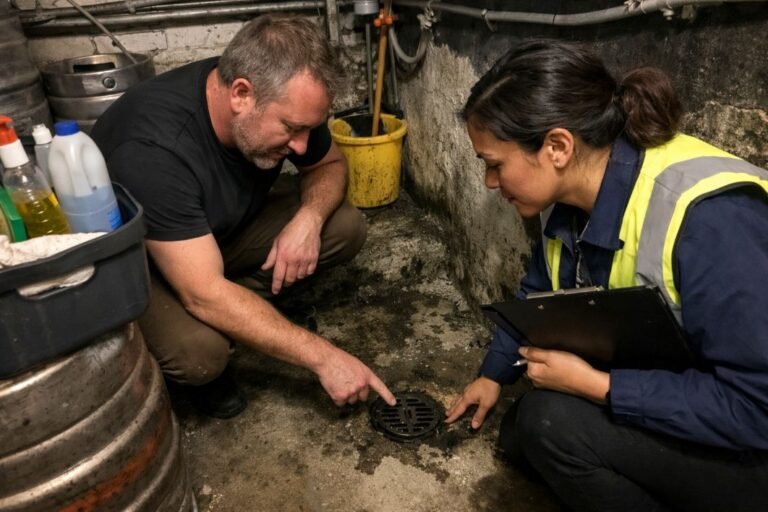
An Environmental Health Officer may identify drainage defects during a hygiene inspection, complaint investigation, or follow-up visit. At this stage, the issue might be recorded in inspection reports with required remedial action and a deadline.
If the problem is serious enough, or if the business fails to act, local council enforcement teams may move to formal measures. That can include statutory notices or improvement notices linked to public health concerns, unsafe conditions, or sanitation failures.
Once a drainage problem starts affecting food safety, customer welfare, or staff hygiene, parts of the premises may become unsuitable for use. A kitchen, wash area, or toilet block may be restricted from use until the issue is resolved. For a hospitality venue, that can quickly affect trading in practical terms even before any formal licence hearing takes place.
Licensing committees become relevant if the wider licensing objectives are affected, including public safety or the prevention of public nuisance. Repeated drainage enforcement, missed compliance deadlines, or evidence that management has failed to respond appropriately can feed into a licence review. In more serious cases, this may lead to conditions being added, activities being restricted, a temporary licence suspension, or revocation.
Timing matters here. A short-lived defect that is resolved promptly looks very different from a recurring compliance breach that appears in multiple visits over months. Authorities tend to focus closely on whether the operator recognised the risk, acted quickly, and kept proper records. Delay often changes the tone of enforcement.
Several legal and regulatory frameworks can affect how drainage compliance is judged in pubs and restaurants. Most operators do not need to memorise every provision, but they do need a clear sense of who may intervene and why.
Environmental Health usually sits at the centre of inspection activity in hospitality settings. Officers may assess the condition of drainage as part of broader hygiene inspections, especially where wastewater management affects kitchens, waste areas, toilets, or customer-facing spaces. A poor inspection outcome does not automatically mean licence action, but it can form part of the compliance record.
Health and Safety Executive involvement is less common in ordinary drainage issues within pubs and restaurants, yet broader workplace risks can overlap if unsafe premises conditions affect staff welfare. Local authorities, meanwhile, often hold several connected powers through Environmental Health, planning, building control, and licensing functions.
From a practical point of view, compliance is often judged through a combination of visible conditions, maintenance records, previous inspection history, and whether the business has responded proportionately. Paperwork matters because it shows whether a problem was managed seriously or allowed to drift.
Pro Tip: Treat any recurring drainage issue as a potential compliance risk rather than a mere inconvenience, and escalate early to avoid enforcement.
Request Emergency Drainage Support
If you are facing an urgent drainage issue affecting your restaurant or pub, contact our specialists for rapid assistance.
Most licence problems linked to drainage follow recognisable patterns. Severe action tends to arise where hygiene risks are clear, enforcement has already taken place, and management response has been poor.
One common scenario involves repeated wastewater backing up into food preparation or wash-up areas. An initial inspection may lead to urgent remedial requirements. If a later visit finds the same issue still affecting sanitation, the matter can move from a hygiene failure to a wider question about whether the premises should continue trading in that condition.
Another pattern appears where customer toilet drainage fails and foul waste or odour affects shared parts of the premises. A single incident may be treated as an urgent operational problem. Ongoing failure, especially in a busy venue with high footfall, can become evidence that the premises are not being managed safely or responsibly.
A third example concerns chronic non-compliance. Local authority case files and licensing hearings often place weight on history. If inspection failures, ignored notices, poor compliance documentation, and repeat offences all sit on the same record, the drainage issue stops looking isolated. It starts to look systemic.
What usually tips the balance is not a dramatic single event. It is the combination of health risk, repeated failure, and a weak response from the operator. That is the point at which closure orders, suspension, or licence revocation become more plausible outcomes.
Busy hospitality sites place unusual pressure on drainage systems. Kitchens generate grease and wastewater daily, toilets serve large numbers of people, and cellar or service areas often stay in constant use. In that setting, a drainage issue can move from hidden defect to operational disruption very fast.
Prevention is best treated as risk management. That means looking at drainage in the same way as refrigeration, food storage, or fire safety: as part of normal operational control rather than an afterthought. Maintenance logs, inspection records, and evidence of timely action all help show that management is paying proper attention.
Professional support becomes particularly relevant where an issue has compliance implications, keeps returning, or could affect a hygiene inspection. In Reading and Berkshire, operators facing urgent drainage concerns may look to specialist firms such as 24hrs Drainage where speed, documentation, and reliable problem resolution matter as much as the physical repair itself.
A few habits tend to make the biggest difference:
High-risk environments rarely get much warning before a small fault becomes a visible problem during service. Good records and prompt escalation are often what separate a manageable interruption from a formal enforcement trail.
Drainage and licensing are often misunderstood because the connection seems indirect until an inspection goes badly. Several assumptions cause trouble.
Myth: Only a major drainage collapse matters. Fact: Smaller defects can still create serious compliance problems if they affect hygiene, produce foul odours, or recur without proper action.
Myth: Inspectors only care about visible food handling areas. Fact: Environmental Health may consider drainage issues in storage areas, toilets, service corridors, waste zones, and any location where sanitation affects safe operation.
Myth: A warning means the licence is safe. Fact: A warning may be an early opportunity to put matters right. If deadlines are missed or the same issue returns, the compliance position can worsen sharply.
Myth: Licence action only happens after a closure. Fact: Closure and licence review are separate processes. A business may face temporary restrictions, formal notices, or licensing scrutiny in different combinations depending on the circumstances.
Myth: Temporary fixes are enough if the venue stays open. Fact: Authorities usually want the underlying risk addressed. A short-term workaround may help manage immediate disruption, but it does not carry much weight if the same defect keeps appearing in inspection outcomes.
Accurate expectations matter here. Overstating the risk can create panic, yet underestimating it can leave an operator exposed at exactly the wrong moment.
Drainage compliance is easiest to manage when it is treated as part of operational resilience rather than emergency housekeeping. Pubs and restaurants already work within overlapping duties around food safety, public health, staffing, and licensing. Drainage belongs in that same picture because failures can affect each of those areas at once.
Resilient operators tend to share a few habits. They keep usable records, respond quickly when conditions change, and treat repeat defects as management issues rather than bad luck. They also recognise that compliance frameworks are ongoing, which means that a good inspection result today does not remove the need for attention tomorrow.
Long-term confidence comes from reducing uncertainty. A venue that can show sensible oversight, timely intervention, and a clear compliance history is in a far stronger position if concerns are raised. In hospitality, that sort of preparedness often matters just as much as the condition of the drains themselves.
Download Our Drainage Compliance Checklist
Access a practical checklist to help you monitor and record drainage maintenance and compliance in your hospitality business.
24hrs Drainage Limited
33 Falmouth Rd, Reading RG2 8QR
0800 020 9198
Opening Hours:
Monday – Sunday : Open and available 24 hours per day
Drain Services
We provide Drainage Services across Berkshire, Hampshire, Surrey, London, Oxfordshire, and the surrounding areas.
Contact Us
If You’re Dealing With Blocked Drains Or Require Drain Repairs, You’ve Come To The Right Destination. Contact Our Team Today At 0800 0209198 For Professional Guidance And A Complimentary, No-Obligation Quote!
We are the premier providers of comprehensive drainage solutions in Reading and throughout Berkshire. With years of experience and a dedicated team of experts, we are your trusted partners for all your domestic and commercial drainage needs.
By subscribing, I agree for my data to be stored and used to receive newsand offers from 24hrs Drainage.
👋 Need urgent drainage help?
We’re available 24/7 in Reading and surrounding areas.
Tap below to speak with our drainage expert now.
Chat on WhatsApp
Fast response | No call-out charges | Nearby
WhatsApp us 24/7