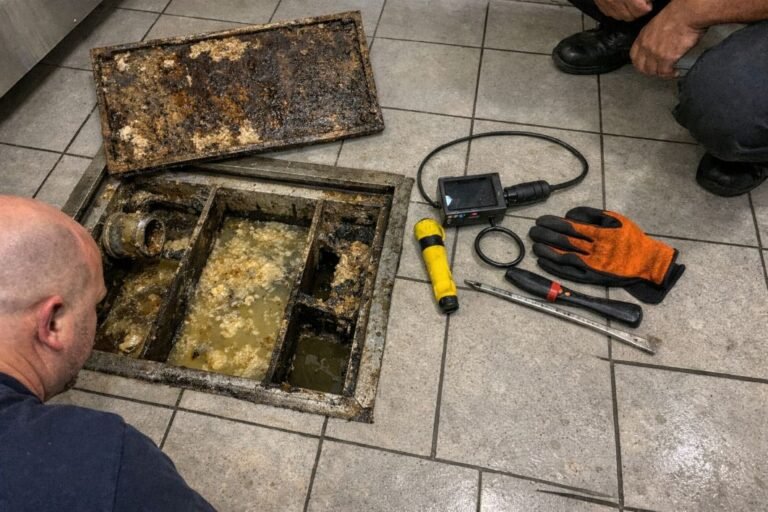
You usually need to act within the timeframe stated in the inspection report, compliance notice, or enforcement letter. That period can be very short if the failure creates an immediate hygiene, drainage, or environmental risk, but a less serious issue may come with a longer rectification window. The safest reading is simple: do not assume you have a grace period unless the written notice says so.
Pro Tip: Organise inspection and repair records chronologically to provide clear evidence in case of follow-up or enforcement.
A failed grease trap inspection does not always mean the same thing in every setting. In one premises, the issue may relate to poor separation of fats, oils and grease. In another, the concern may be record keeping, overflow risk, or a system that no longer meets the site’s needs. What matters first is the inspection outcome in writing.
Inspections may be linked to local councils, Environmental Health, property management requirements, Building Regulations considerations, or wider environmental expectations where discharge issues are involved. Food businesses may also feel pressure from Food Standards Agency related hygiene expectations, even if the direct enforcement route sits elsewhere.
Three points usually matter straight away:
A common misunderstanding is that every inspection failure comes with an informal grace period. Some do not. If the notice sets a date, that date is the compliance deadline that matters, and informal assumptions carry very little weight if enforcement later follows.
Request a Compliance Audit
Get a comprehensive review of your grease trap and drainage compliance to minimise risk and avoid unexpected enforcement action.
The speed required depends on the notice, the risk level, and the setting in which the grease trap is used. A statutory deadline has more weight than an informal recommendation, but even a non-statutory warning can escalate if a business ignores it.
Severity changes everything. An immediate hazard, such as backing up waste, foul odours affecting food areas, or signs of discharge problems, is likely to attract a shorter compliance timeframe than a technical shortfall with no obvious active impact. Environmental Health Officers and local authority enforcement teams tend to focus on present risk, not just paperwork.
Business type also affects the picture. A busy commercial kitchen in a dense town centre can face tighter scrutiny than a lower-use site with limited public exposure. Commercial property managers may also impose their own contractual deadlines where leases, shared drainage, or building management obligations are involved.
A useful way to read the grease trap inspection process is to separate the issue into broad categories:
Written notices usually state more than one requirement. One date may relate to the start of remedial action, and another may apply to evidence, follow-up inspection, or proof that the problem has been resolved. A business that reads only the headline deadline can miss the detail that triggers escalation.
Delay can move a grease trap issue from a compliance problem into a legal and financial one. Enforcement does not always begin with a fine, but the path from warning to penalty can be shorter than many operators expect.
Possible consequences include:
Some cases remain administrative. Others can become more serious, particularly if a business continues operating with a known fault that causes overflow, contamination, nuisance, or discharge issues. Environmental Health may take a different view once there is evidence that a warning was ignored.
A first offence does not guarantee leniency. Regulators and courts, including the Magistrates’ Court where relevant matters can be heard, often look at the facts, the risk, and the response. A prompt, documented effort to remedy the problem reads very differently from silence or delay, particularly where an insurance provider later asks when the issue was first identified.
Pro Tip: If an inspection report is unclear about deadlines, contact the issuing authority immediately to confirm your compliance timeframe.
Arrange Emergency Grease Trap Support
Secure rapid, professional help for urgent grease trap inspection failures before deadlines jeopardise your business.
Once a grease trap inspection failure has been recorded, the priority is to restore compliance in a way that can be evidenced. Speed matters, but so does documentation.
The usual focus is on four outcomes:
Documentation often carries more weight than businesses expect. A site may have arranged grease trap rectification promptly, but if it cannot show dates, findings, and proof of attendance, the file can still look incomplete.
Follow-up inspections are also part of the picture. Regaining compliance is about doing the work. In many cases, it also means showing that the issue has been addressed within the stated window and in a form the authority can accept.
National rules do not always produce identical local enforcement behaviour. Reading Borough Council, neighbouring Berkshire local authorities, and regional Environmental Health teams may approach timing, evidence, and follow-up with slightly different emphasis.
One area may focus closely on nuisance, shared drainage impact, or food premises hygiene. Another may place greater weight on discharge concerns, landlord obligations, or the wording of a previous local authority notice. That is why generic online advice about local grease trap rules can be unreliable if it ignores area-specific requirements.
In practical terms, local context can affect:
Across Reading and Berkshire, response expectations are often shaped by how the site affects neighbouring properties, public health considerations, and the history of the premises. A unit in a busy mixed-use block may be viewed differently from a standalone site with no recent complaints, which means that local knowledge has real value long before any fine is discussed.
Some grease trap failures can be managed internally at an administrative level, especially if the issue is limited to records or scheduling. Others move beyond that very quickly.
Professional drainage support becomes necessary where the site faces a short enforcement deadline, an active blockage or overflow risk, repeated inspection failure, or a situation where the business must provide technical evidence to show the problem has been resolved. In those cases, delay often comes from uncertainty over what the authority will accept, not from the repair itself.
Experienced contractors can also matter where the consequences reach beyond one kitchen or one tenant. Shared systems, disputed responsibility, environmental concerns, and time-sensitive commercial operations tend to need professional documentation as well as remedial action. In Berkshire, companies such as 24hrs Drainage are often brought in at that stage because the issue has already become operational, not merely inconvenient.
Internal teams usually know when the matter has outgrown routine handling. Once deadlines, evidence, and business continuity are all in play at the same time, expert intervention becomes part of the compliance response rather than an optional extra.
Several myths make grease trap inspection failures harder to manage than they need to be. Most come from assumption, not from the wording of the notice.
One common belief is that every failed inspection comes with automatic extra time. In reality, a grace period exists only if the authority or compliance officer has actually given one.
Another misunderstanding is that a minor failure can wait because it is not yet causing visible disruption. Small defects can still breach grease management rules, especially if the site has already been warned or the issue affects hygiene, drainage, or discharge standards.
Some operators also confuse national guidance with local enforcement practice. Regulatory bodies may set broad expectations, but local authorities often decide how those expectations are applied on the ground, including how quickly they want evidence of rectification.
A final misconception is that any contractor attendance will satisfy the authority. Compliance support usually needs more than a visit. It often depends on whether the business can produce suitable records, reports, and proof that the inspection failure has been dealt with in terms that match the notice. The safest approach is to treat the written deadline as real, the paperwork as important, and the local context as something that can change the pace significantly.
Download the Compliance Checklist
Access a practical checklist to help keep your site on track with grease trap maintenance, inspections, and required documentation.
24hrs Drainage Limited
33 Falmouth Rd, Reading RG2 8QR
0800 020 9198
Opening Hours:
Monday – Sunday : Open and available 24 hours per day
Drain Services
We provide Drainage Services across Berkshire, Hampshire, Surrey, London, Oxfordshire, and the surrounding areas.
Contact Us
If You’re Dealing With Blocked Drains Or Require Drain Repairs, You’ve Come To The Right Destination. Contact Our Team Today At 0800 0209198 For Professional Guidance And A Complimentary, No-Obligation Quote!
We are the premier providers of comprehensive drainage solutions in Reading and throughout Berkshire. With years of experience and a dedicated team of experts, we are your trusted partners for all your domestic and commercial drainage needs.
By subscribing, I agree for my data to be stored and used to receive newsand offers from 24hrs Drainage.
👋 Need urgent drainage help?
We’re available 24/7 in Reading and surrounding areas.
Tap below to speak with our drainage expert now.
Chat on WhatsApp
Fast response | No call-out charges | Nearby
WhatsApp us 24/7