

Yes, a persistent sewage smell indoors can often point to underlying drainage issues, not just a dry or faulty trap. If the smell lingers despite flushing water through sinks or floor gullies, there is a strong possibility the problem lies more detailed in the system.

Pro Tip: Professionally installed vent stacks can prevent pressure imbalances that cause odours to breach traps. Ensure venting remains unobstructed during renovations.
When an unpleasant odour starts to drift through a home or workplace, many people assume it comes from a dried-out U-bend. Running the tap usually seems like the logical next step. Sometimes, that does the trick. But when the smell persists, frustration sets in. The trap looks fine, water is flowing, yet the foul smell hangs in the air.
This disconnect often signals a more complex situation. Drainage smells that return moments or hours after flushing a system can mean the issue is no longer contained to one fixture. Odours travel, especially through poorly vented pipework or compromised seals. Even functioning traps can allow gases to escape if upstream pressure imbalances are involved.
It is worth noting that modern drainage setups rely on a network of connections and vents to manage air movement and water flow. When that balance is disrupted, smells can migrate far from their source. Homeowners and landlords are often surprised to learn that a smell near the kitchen sink could originate from a fault behind a wall or beneath a floor slab.
Over time, misdiagnosing a smell as a minor fault can delay proper action and extend the problem into multiple areas of a property. And the longer that uncertainty persists, the more likely it is that health, structural, or legal exposure will follow.
Some smells are more than a surface annoyance. They hint at the kind of fault that impacts the integrity of an entire system.
Here are signs that a sewage odour may be more than localised:
These symptoms can link to more detailed problems such as blocked vent stacks, collapsed pipes, compromised joints, or improper sealing between shared systems. Properties in older developments or those with mixed-use drainage layouts are often more vulnerable to such system-level faults.
Pressure fluctuations within pipes can draw air in or out unpredictably. In commercial settings, this might even affect neighbouring units or basements. Foul smells may also signal the first signs of restricted flow that, left unresolved, could lead to backflow or flooding.
If a smell persists even when everything visible appears functional, professional investigation becomes the clearest path to resolution. The earlier it happens, the smaller the disruption and liability risk becomes.
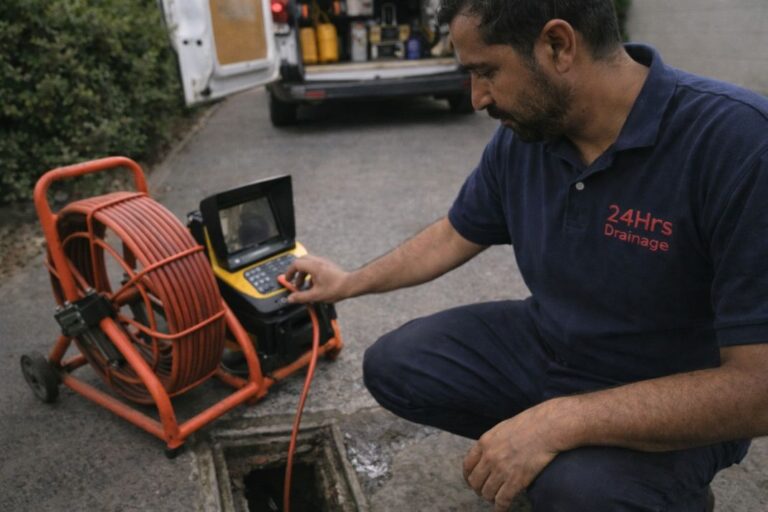
Book a CCTV Drain Survey
Quickly identify the source of persistent smells with a professional drain inspection using CCTV technology.
Drain traps have a specific job, holding water to block gases from rising back into a room. But that simple mechanism only works when the broader system is functioning as intended.
Sometimes, traps fail because of direct evaporation. That is common in rarely used rooms. But in occupied areas where usage is regular, a dry trap should trigger further investigation.
Several things can override a working trap:
Running water to refill a trap and seeing no improvement can feel discouraging. Yet this is the moment where households and facilities teams must resist the urge to delay. In flats, offices, or shared buildings, smells from an adjacent unit can transfer through ceiling voids or shared spaces, and no amount of bleach will affect that.
Recognising when a working trap is not a guarantee of system health is the key to minimising further damage or escalation.
Pro Tip: Shared walls or service voids in flats often let smells travel between units. Investigate beyond your own space if odours persist despite internal cleaning.
Speak to a Drainage Expert
Unsure whether your issue is minor or systemic? Our team is ready to assess and advise without delay.
Lingering odour is more than a nuisance. It puts property condition, habitability, and legal standing at risk.
Failure to address persistent smells can lead to:
Smells that start as background noise can develop into evidence of more detailed structural failures. Over time, trapped moisture or invisible leaks behind walls can fuel mould growth, attract pests, and compromise materials. When incidents reach that stage, remedial work expands to include electrical, flooring, or insulation repairs, raising both cost and downtime significantly.
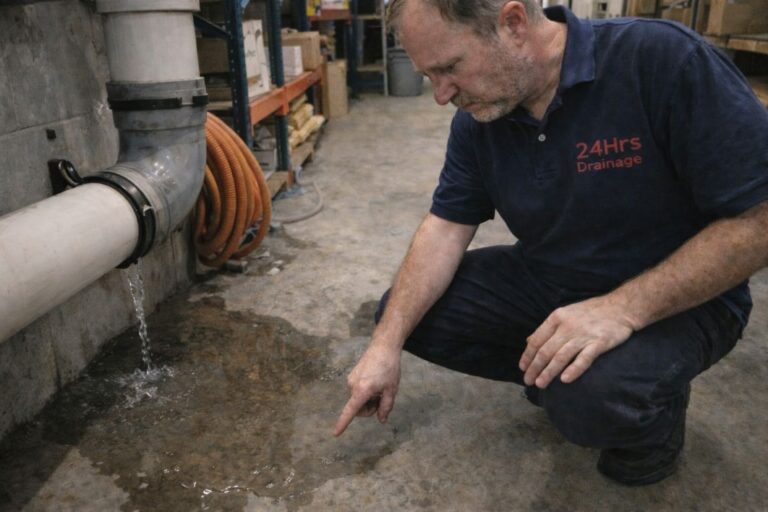
There comes a point where continued guesswork carries more risk than engagement. Recognising when that moment has arrived saves time and helps restore clarity.
Professional input should be considered when:
In such cases, a targeted investigation, such as a CCTV drain survey or air pressure check, and can rule out hidden system faults. For properties in Reading, Berkshire, and the surrounding counties, specialist teams like 24hrs Drainage are equipped to provide rapid assessments supported by documentation suitable for compliance or insurance conditions.
Ultimately, seeking specialist help is not about challenge. It is about knowing that when persistent smells affect living or operational conditions, the best outcome comes from accurate diagnosis and confident resolution.
Request a Drainage Health Check
Get your system assessed before hidden faults become costly repairs in homes or buildings.
24hrs Drainage Limited
33 Falmouth Rd, Reading RG2 8QR
0800 020 9198
Opening Hours:
Monday – Sunday : Open and available 24 hours per day
Drain Services
We provide Drainage Services across Berkshire, Hampshire, Surrey, London, Oxfordshire, and the surrounding areas.
Contact Us
If You’re Dealing With Blocked Drains Or Require Drain Repairs, You’ve Come To The Right Destination. Contact Our Team Today At 0800 0209198 For Professional Guidance And A Complimentary, No-Obligation Quote!
We are the premier providers of comprehensive drainage solutions in Reading and throughout Berkshire. With years of experience and a dedicated team of experts, we are your trusted partners for all your domestic and commercial drainage needs.
By subscribing, I agree for my data to be stored and used to receive newsand offers from 24hrs Drainage.
👋 Need urgent drainage help?
We’re available 24/7 in Reading and surrounding areas.
Tap below to speak with our drainage expert now.
Chat on WhatsApp
Fast response | No call-out charges | Nearby
WhatsApp us 24/7